
Although this summary takes into consideration all substandards relevant to Standard 1 and 2, this passage is directly addressing:
1.2 Demonstrate knowledge and understanding of research into how students learn and the implications for teaching.
2.5 Know and understand literacy and numeracy teaching strategies and their application in teaching areas.

1.2 Demonstrate knowledge and understanding of research into how students learn and the implications for teaching
Motivation and Personalised Learning:
Through my degree I have come to the understanding that teaching is about engaging students in their learning by making them active participants in the classroom. Understanding that students need to be engaged on different levels has molded my teaching practice. Perhaps the most significant factor in teaching is establishing motivation in students to want to engage with the content, therein lies the challenge for teachers, as stated by McInerney and McInerney (2010)
“Curiosity is a major element of intrinsic motivation”
- Dennis M McInerney, Valentia McInerney (2010)Educational Psychology, Constructing Learning, 5th ed. Pearson
To ensure that I motivate my students, I base my learning programs on their interests as much as possible. I also ensure that I incorporate a wide range of interactive learning experiences, based on constructivist and active learning strategies to maximize the depth of learning, and provide students with meaningful learning experiences.
An example of understanding how students can learn through meaningful experiences is the implementation of my pen pal program during my PI. I decided to implement a pen pal program because it offers a number of significant inter-disciplinary benefits for students, including:
1. valuable practice at writing letters in the proper format (Language Arts standard)
2. encourages the students to regulate their own learning by implementing ‘homework with parents’ concept and the ‘deadline’ concept,
3. allows students to take ownership of their writing voice by only editing the spelling/ grammar of their letters, and reminding them that we will not edit content
4. increased awareness of societies and cultures from around the Australia (can be tied into Social Studies, Geography, and more),
5. a chance to maintain ongoing communication with people who live far away ,
Because the students had demonstrated letter writing capabilities and enthusiasm during previous classes, I decided this would be something they would enjoy and could only add value to their current literacy program. The success of the program ensured that it will continue in the class.
Cross-curriculum learning
Another aspect to understanding how students learn is the concept of interlinking concepts through curriculum areas to reinforce learning. The importance of this is emphasised in the VELS website
"Cross-curricular learning involves students in applying knowledge, principles, and/or values to more than one discipline or subject area which may be related through a central theme, issue, big idea or experience."
http://vels.vcaa.vic.edu.au/support/crosscurricular/index.html
The pen pal program had much scope for interlinking with other curriculum areas, specifically:
Geography: we researched the area of Perth and Western Australia as a class, and made a map of the general area in which the student’s lived
Social Sciences: we discussed how our Perth pen pal's lifestyle would differ to ours, considering the variance in weather, interests and recreational activities. We also discussed the concept of being a good friend by writing interesting letters and showing interest in the other person’s life.
History: as a class we research the history of the area in which our pen pals lived, as well as the city of Fremantle.
The use of themes and topics can also contribute to deeper learning and higher retention During my Professional Internship I ensured that I structured my program around themes and topics, interlinking as many areas of the curriculum as possible. An example of this is the theme of setting and location. As a class we explored this through literacy – creating a postcard for Possum Magic characters, and through art by creating a setting for an object. During the art class, the students could choose an item in which to create a setting for the item to ‘live,’ they were to consider what the item ate, where it lived, what family/ surroundings might be surrounding it and what the general area might look like. At the conclusion of the lesson, I took photos of the item within the setting and the students were to present their concept. An example of this is below:
Both examples demonstrate careful consideration for the instructions of the task, the natural or typical environment in which the objects might exist in, perspective and creativity. The students were keen to follow this up with an open writing task.
Creation of a positive learning environment
Another aspect of understanding how students learn is the creation of a happy and harmonious place to learn and explore. During my PI I considered the creation of both the physical and emotional environment to be fluid, changeable and collaborative between teacher and students.
Structuring the Emotional Environment
During my PI, I sought to create a caring, nurturing learning environment, one which promotes positive attitudes towards learning, confidence and enthusiasm. Specifically:
· I establish clear goals and rules,
· I demonstrate a passion for teaching and the individual student’s learning progress through immediate feedback
· I ensure all students respect the rights of others, both peers and adults.This approach to teaching and learning results in:
· High levels of student engagement.
· Authentic teaching and learning.
· Student’s experiencing success and motivation and therefore the achievement of a positive, supportive classroom culture.
Structuring the Physical Environment
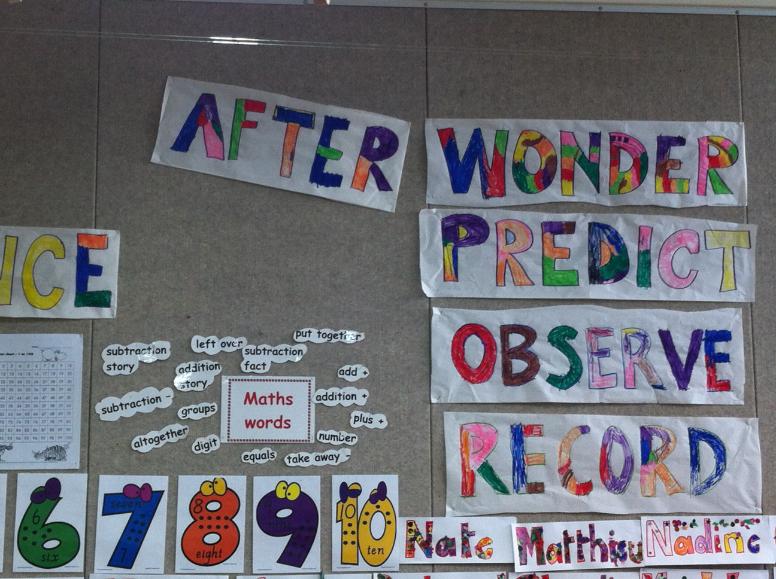
In structuring the physical environment for learning I ensure that the decoration on the walls is colorful, provides visual ‘cues’ for learning (such as times stables charts, or grammatical charts) and displays the student’s work. By way of example, please see below photographs of the classroom from my Professional Practicum below. This particular example below shows text cues to concepts focusing on during science unit and maths units:

2.5 Know and understand literacy and numeracy teaching strategies and their application in teaching areas
Teaching Literacy
The school I completed my Professional Practicum in had an extensive literacy program in which they devoted two hours each day of the week to literacy focus groups. The focus groups were selected based on reading level and ability. The execution of this program meant that teachers could:
- access students effectively in a small group
- focus on one aspect of literacy based on the VELS and ACARA standards such as character establishment, grammar, punctuation or comprehension
- assess children one on one and in a group setting and,
- progress children at their own pace.
I felt this was a wonderful example of personalised learning for literacy, and saw marked improvement in the children in my group and that of my teaching peers.Together with this program, I wanted to implement a new concept though I took a risk. I noticed that the student’s enjoyed being read to via picture books with a strong focus on character development and decided to see if they were ready for a serial reader – I thought I’d try it with them, though ensure that we used comprehension strategies, various activities and movement activities (such as role play…etc.) to break up the book and avoid boredom.I used three comprehension strategies for the class read-aloud serial. They are:
- Strategy 1: Think about the story. When I read the story, I stop at various points. My students and I then discuss what's happening and what we think will happen next. We also make predictions about the story when we begin a new chapter and consider possible decisions the main characters will make
- Strategy 2: Map the characters. As we read the story, we continually refer back to what we already know about the characters and add new information – this is generally done prior to commencing the reading for that day also to anchor the children into prior knowledge and the context of the story. The children make predictions based on this information.
- Strategy 3: Kinetic/ Movement activities. At the conclusion of each chapter we would complete a writing, drawing, or dramatic activity such as role playing a scene.
Teaching Mathematics
At the commencement of a mathematics unit of work I use pre-assessment strategies to determine a starting point for each individual student, and a teaching approach appropriate to their developmental needs.
The use of floor work, concrete materials and using authentic situational problems scaffolds student's with a foundation to climb to the abstract
To achieve this, I utilised my host school’s Assessment Schedule as well as personalised assessments. More specifically I used:
- On-going observations,
- Student Friendly first Steps Progress Maps
- VELS Progression Points as this was the standard enforced by the host school
- ACARA Standards
Collecting this data and information means that I can:
- Incorporate a specific teaching focus.
- Structure student groupings into either like-need groups and/or mixed ability groups.
- Use teaching approaches appropriate to the individual’s needs.
I plan lessons and assessments that are authentic and incorporate deep levels of thinking skills, challenging students to apply their learning outside the classroom. I believe that for students to be committed to learning in the classroom, my lessons need to be relevant and appropriate to life experiences. This influences my lesson planning greatly and also ensures deeper engagement. I often feel that providing homework to take home and directly apply every day experiences to mathematical concepts can be a source of deeper learning, giving meaning to facts and bringing theory to life. An example of this is whilst on a Professional Practicum, I challenged the students to become ‘division investigators’ and find three examples of division happening at their home. They could record their answers in an open way, using words or diagrams to illustrate their example, here is the worksheet provided:
|
division take home.pdf Size : 86.216 Kb Type : pdf |

This was a wonderful exercise and the students really embodied the concept of division – most importantly, they grasped the idea that division needs to always be equal and relates to the everyday environment.
To strike motivation in my students within the division unit, we made pizzas as a class, dividing the pieces equally as we went along.

To introduce the theory component of teaching math I began with a great deal of floor work with concrete materials and progressed to using think boards to allow students to demonstrate their understanding. Please see and example of this below:

The think board concept was terrific in allowing students to visually see maths problems represented in different ways.
I often inserted games to introduce concepts, such as estimation. One in particular was enacted on a daily basis. The students were often consulted on what they would like to do – with the teacher giving the class two options to vote upon. Those in favour of option 1 would go to one side of the room and those in favor of option 2 to the other. The students were then instructed to arrange themselves from tallest to shortest so I could count them. To the students, it appeared as a game but they were actually honing their comparison skills, being introduced to measurement and ordering. In particular, I was drawing them to understanding a significant aspect from the K-10 Syllabus Overview for mathematics/ measurement (First Steps):
“KU1: We can directly compare objects and events to say which has more length, mass, capacity, area, volume, angle or time.”
Using this everyday activity allowed me to smoothly move to higher concepts of measurement from a cognitive progression that the students had foundational, active learning experiences to draw from. To ensure that the students had grasped the concept of equal grouping through division the planning team and I arranged a post-assessment to formally assess their understanding, please see this below.
|
Post Assessment Task Abstract - DIVISON.docx Size : 18.836 Kb Type : docx |
Action Plan: It is imperative to stay current with innovative teaching strategies for teaching literacy and numeracy skills and to this end I will complete professional development courses on a regular basis. The Department of Education and Early Child Development (Victoria) runs initiatives designed for teachers to remain current with teaching literacy and numeracy skills:
http://www.education.vic.gov.au/studentlearning/litnum/default.htm
The Australian Government Quality Teacher Program (AGQTP), is the Australian Government’s program for improving teacher quality:
"A national program to update and improve Australian teachers' skills and help lift the status of teaching in schools. It focuses on improving teacher skills in literacy, numeracy, mathematics, science, information technology and vocational education in schools."
http://www.education.vic.gov.au/proflearning/agqtp/default.htm
I plan to complete this course by mid 2013 as the course runs during term 2 though exact dates for 2013 intake are not yet confirmed I believe.
Action Plan, Use of "lesson study" program to improve an understanding of how students learn: The Department of Education and Early Childhood Development suggest that student utilize the "Lesson Study" program to develop a deeper understanding of how students learn specific subject matter and receive feedback, as written regarding the program:
Lesson Study
"Lesson
study helps teachers to prepare lesson plans and develop a deeper
understanding of how students learn specific subject matter. A small
group of teachers meets regularly to plan, design, implement, evaluate
and refine lessons for a unit of work. One member of the team conducts
the lesson while other members of the team observe it. In concert with
their observations and reflection, the lesson is modified and may be
taught again by another member of the team. The aim of the model is to
promote a process whereby teachers experience gradual and incremental
professional growth through the collaborative development of lessons."
http://www.eduweb.vic.gov.au/edulibrary/public/staffdev/teacher/induction/ProfLearningInEffectiveSchools.pdf
Once teaching, I will utilize this program (hopefully as early as March 2013) to develop my understanding of how students learn and how I might be able to enrich my lesson plans further.